

How to Clear Roof Valleys Without Causing Damage

by
A roof valley can hold far more water than most people realize. When leaves, moss, twigs, and roof grit build up in this narrow channel, rainwater cannot reach the gutters as it should. If you are wondering how to clear roof valleys, the safest answer is to remove loose debris carefully, avoid damaging the roofing material, and stop before the job becomes a risky roof repair.
A clear valley protects more than the roof surface. It helps prevent water from backing up beneath shingles or tiles, overflowing into gutters, soaking fascia boards, and finding its way into the roof space. For homeowners and property managers, that makes valley maintenance a sensible part of looking after the whole roofline.
What a roof valley does
A roof valley is the angled channel where two roof slopes meet. It collects runoff from both sides of the roof and directs it toward the gutter. During a heavy downpour, that one section may be handling a large volume of water, especially on a house with extensions, dormers, conservatories, or several roof levels.
Valleys are commonly lined with metal flashing, membrane, or a purpose-made valley system beneath the roof covering. These materials must remain clear and properly seated. A blockage does not always look serious from ground level, but even a shallow pile of wet leaves can slow the water enough to cause trouble.
The usual warning signs are water spilling over the edge of a valley, damp staining on ceilings or walls, moss collecting in one roof channel, or gutters overflowing beneath an otherwise clean roof. You may also notice granules, broken tile fragments, or rusty marks around the valley outlet. These signs call for a closer inspection, not simply a quick sweep from a ladder.
How to clear roof valleys safely
Roof work carries real risk. Wet moss, loose grit, steep pitches, fragile tiles, and awkward access make a roof valley one of the less forgiving places to work. If you cannot reach it safely from the ground, a stable access platform, or a properly positioned ladder, arrange professional help rather than climbing onto the roof.
Choose a dry, calm day with good visibility. Never work on a wet, icy, windy, or frosty roof. Tell someone you are working outside, keep children and pets clear of the area below, and do not lean a ladder directly against a gutter or weak roof edge.
Start with a ground-level check
Before attempting any clearing, look up from several angles. Check whether the valley is visibly packed with leaves or whether debris has gathered where it meets the gutter. Inspect the gutter below as well. A blocked downspout can make it appear that the valley is the problem when water is actually backing up from the drainage system underneath.
Binoculars or a phone camera with zoom can help you see the condition of the valley without leaving the ground. Look for slipped tiles, lifted flashing, cracked mortar, sagging gutter sections, or thick moss growth. If any of these are present, cleaning alone may not solve the issue.
Remove loose debris gently
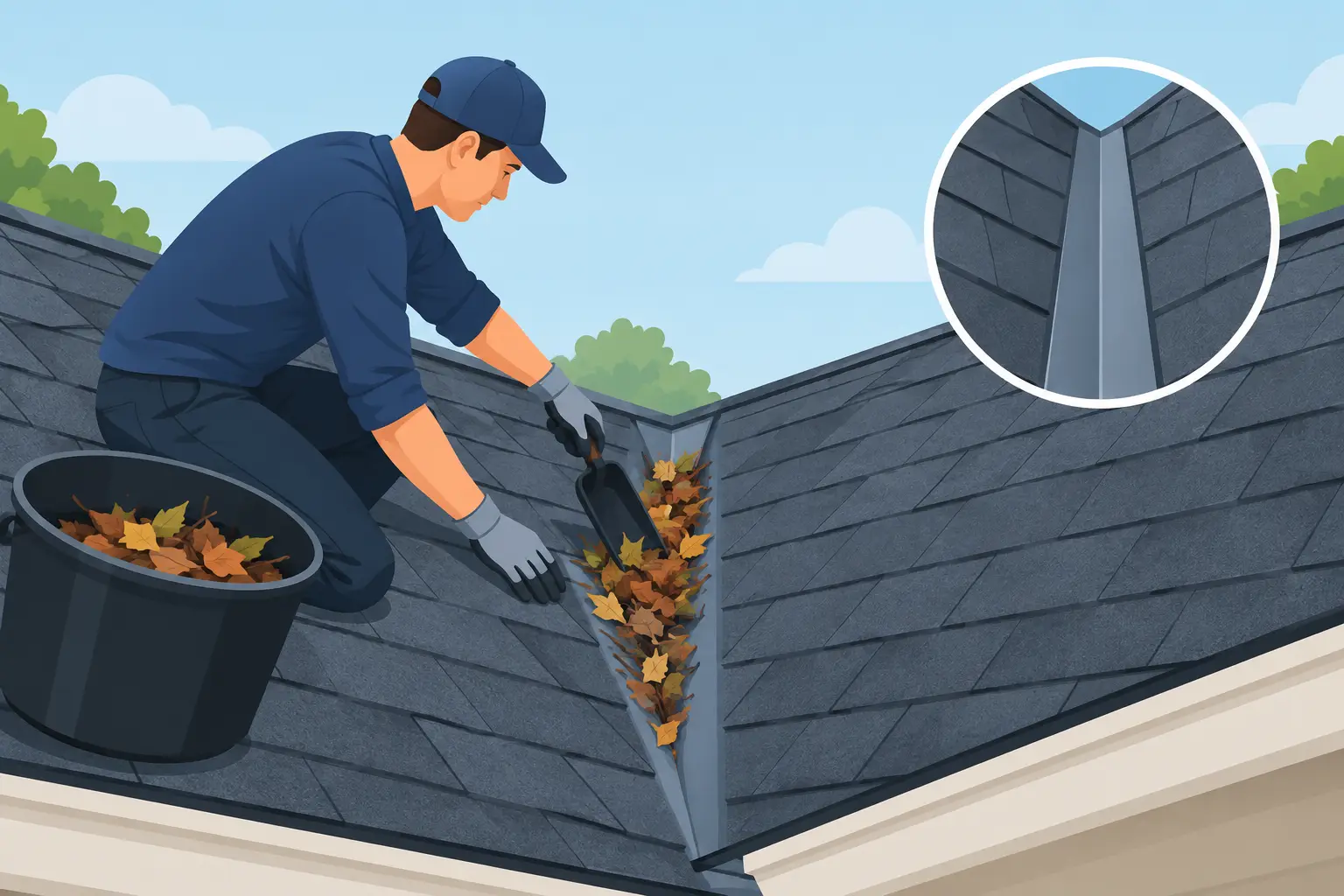
Where safe access is available, wear gloves and remove dry leaves, twigs, and loose moss by hand. Start at the top of the valley and work downward so debris is not pushed farther into the channel. Place the waste in a bucket or bag rather than throwing it into the gutter, where it can block the outlet or downspout.
Use a soft hand brush only for light material left behind. Avoid metal tools, hard scrapers, and aggressive brushing. They can scratch metal valley liners, lift the edge of a shingle, dislodge a tile, or tear a membrane that is already aging.
Do not use a leaf blower on the roof unless you are trained, securely positioned, and certain the roof material is sound. A blower may force debris beneath tiles or flashings, scatter moss into gutters, and make footing less safe. It can also hide a problem rather than remove it properly.
Check the valley outlet and gutter
The lower end of the valley is where blockages often cause the most damage. Once leaves become wet and compacted, they form a dam at the point where water should enter the gutter. Clear this area by hand, then inspect the gutter for sludge, moss, and standing water.
Next, check that the downspout is flowing freely. Water should travel from the valley, into the gutter, through the outlet, and away from the building without pooling. If the downspout is blocked, clearing the roof valley will only offer a temporary improvement. A proper gutter service includes checking this whole route, not just the visible debris at the top.
Test the drainage with a gentle flow of water
Once the valley and gutter are clear, use a gentle hose flow to test drainage. Begin near the top of the valley and watch where the water goes. It should move smoothly without collecting, flowing sideways beneath the roof covering, or jumping over the gutter.
Do not use a pressure washer on a roof valley. High-pressure water can force its way under shingles or tiles, damage protective surfaces, disturb pointing, and drive water into areas that normally stay dry. Pressure washing may look effective for a few minutes, but it can create a much larger repair bill.
When clearing a roof valley is not enough
Debris is often the immediate problem, but it is not always the only one. If water continues to back up after the valley and gutters have been cleared, there may be a fault with the roof covering or drainage layout.
A professional inspection is worthwhile if you see cracked or slipped tiles, loose flashing, corroded valley metal, exposed underlayment, recurring moss, or water marks indoors. The same applies if the valley fills up again soon after cleaning. That can mean nearby overhanging trees, poor gutter fall, a damaged outlet, or a valley profile that is too narrow for the amount of runoff it receives.
Older properties can be especially prone to hidden valley problems. Mortar bedding may have failed, metal may have worn thin, and previous repairs may have been carried out over an existing defect. In these cases, repeated cleaning is not value for money. The cause needs to be found and repaired before water damages timbers, insulation, ceilings, or exterior walls.
How often should roof valleys be cleared?
For most properties, inspect roof valleys at least twice a year, usually in spring and late fall. Homes beneath mature trees may need checks more often, particularly after storms or periods of heavy leaf fall. Properties with mossy roofs should also be monitored because moss breaks free in clumps and quickly blocks narrow drainage channels.
There is a balance to strike. Regular visual checks are sensible, but climbing onto a roof every few weeks is not. If the valley repeatedly collects debris, it may be better to arrange scheduled exterior maintenance and address the source, such as encroaching branches or a gutter system that needs adjustment.
Protect the rest of the roofline while you are there
A blocked roof valley rarely affects only one area. Water that cannot drain properly often ends up overflowing into gutters, soaking fascia boards, staining soffits, and adding weight to already struggling gutter brackets. Check for drips at joints, gutter sections pulling away from the roofline, and downspout outlets discharging too close to the building.
This is why Steve’s Gutters approaches maintenance as more than a clean-only job. A useful inspection looks at the valley, the gutter run, the outlets, downspouts, and visible roofline condition together. Clearing leaves is straightforward. Identifying why water is not moving where it should is what helps prevent the same problem returning.
A roof valley should carry rainwater away quietly and efficiently. If yours is blocked, treat it early, work only within safe limits, and get it inspected when there is any sign of damage. A careful response now can save you from dealing with an internal leak when the next heavy rain arrives.
Recommended Posts

Seamless Versus Sectional Gutters: Which Is Best?
October 16, 2026

Can Dirty Gutters Attract Pests? Yes, Here’s Why
October 14, 2026

A Guide to Replacing Fascias on Your Home
October 12, 2026