

How to Check Downpipe Flow Before Water Backs Up

by
A gutter can look clean from the ground and still send rainwater straight over the edge when the downpipe is blocked. Knowing how to check downpipe flow gives you an early warning before overflowing water stains brickwork, soaks foundations, damages siding, or causes damp around doors and windows.
In the US, these pipes are often called downspouts. Here, we use downpipe to mean the vertical pipe that carries water from the gutter to the drain, splash block, or ground-level outlet. A simple flow test can reveal whether the problem is leaves, roof moss, a crushed section of pipe, or a blockage below ground.
Start With Safety, Not a Ladder
Do not climb onto a roof to inspect guttering. Wet roofing, unstable ladders, and awkward working positions are a poor combination, especially when you are trying to handle a hose at the same time. Most downpipe flow checks can be completed from ground level, from a stable ladder only where necessary, or by a trained gutter professional.
Choose a dry day so you can see where the test water is going. If the gutter is visibly overflowing during rain, stay clear of the area below it. Water may be carrying loose debris, and a failed gutter bracket or joint can give way without much warning.
Before testing, walk around the property and look for obvious signs of trouble. Green staining on walls, damp patches below gutter joints, peeling paint, eroded soil, and watermarks near the foundation all suggest that rainwater is not being carried away as it should be.
How to Check Downpipe Flow With a Hose
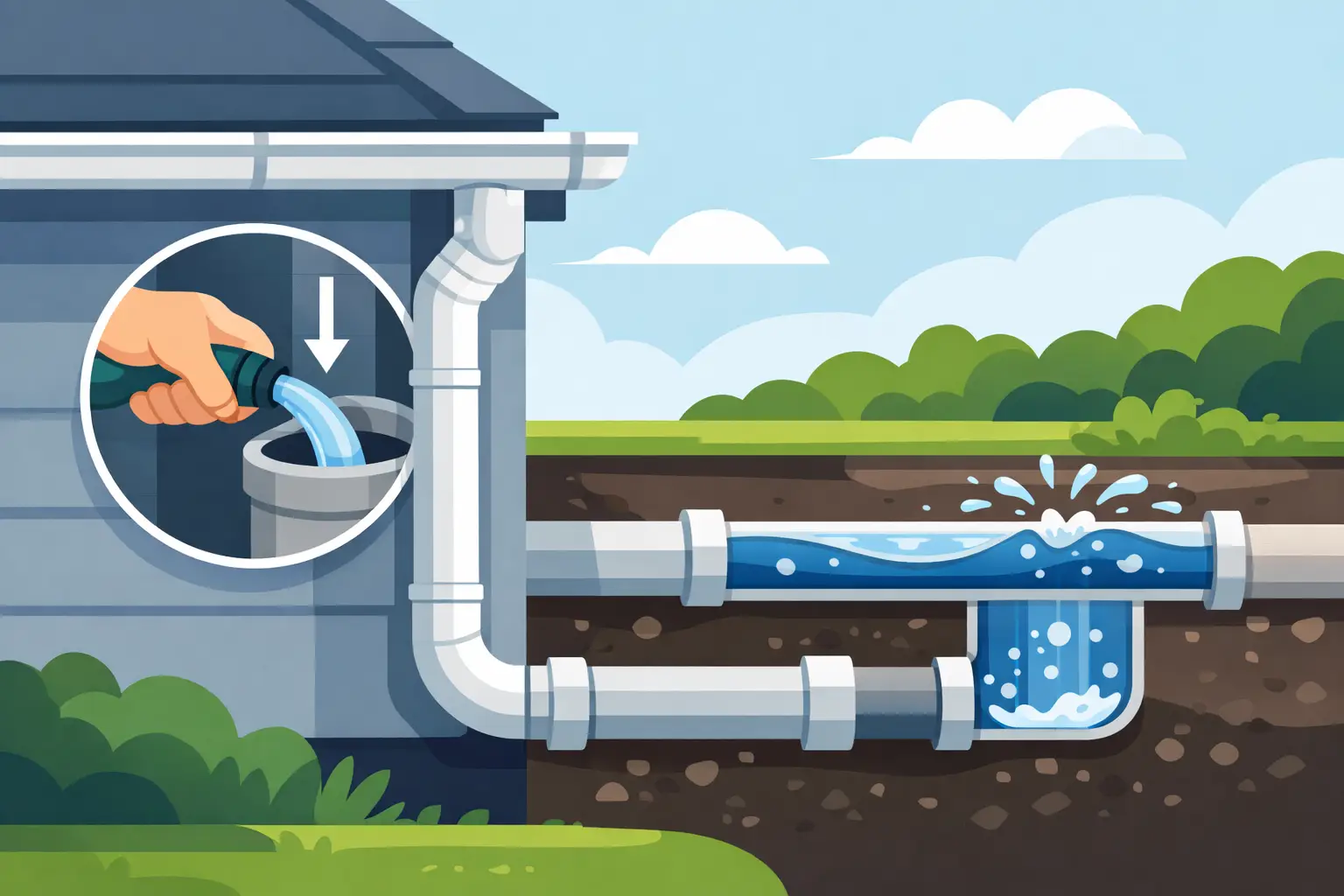
The most reliable basic test is to run water into the gutter near the downpipe outlet. Use a garden hose on a steady, moderate setting. High pressure can force debris into a tighter blockage or cause water to jump out of shallow gutters, which makes the result harder to judge.
Watch the bottom of the downpipe while someone runs the hose. Water should appear at the outlet within a short time and flow freely away from the house. If it trickles, pulses, backs up into the gutter, or leaks from a joint, there is a restriction or defect that needs attention.
Start with a small amount of water rather than filling the whole gutter at once. If it drains correctly, increase the flow for a minute or two. This helps identify partial blockages that only become obvious in heavier rainfall.
If you cannot safely reach the gutter with a hose, test at a lower access point instead. Some downpipes have a removable bottom section, a cleanout, or a hopper opening. Removing a section should only be done if it is safely accessible and you can refit it correctly without damaging old brackets or seals.
What normal flow should look like
A working downpipe does not need to shoot water out at great force. It should accept a consistent hose flow without the gutter level rising to the outlet, and it should discharge steadily at the bottom. Water should then be directed away from the building, not pooling against the foundation.
A slow flow is not always a complete blockage. The pipe may contain wet leaves, compacted roof grit, moss, silt, or a nest that allows a little water through but cannot cope with a downpour. These partial blockages are often the reason a gutter appears fine on a light rainy day but overflows in a storm.
Check Where the Water Comes Out
Do not stop the inspection once water reaches the bottom. The outlet can be clear while the drainage route beyond it is blocked or poorly positioned. Check whether water runs onto a splash block, into a surface drain, or into a buried drain connection.
If the downpipe feeds into an underground drain and water immediately rises from the gully or backs up around the pipe, the problem may be below ground rather than in the gutter system. A gutter clean alone will not fix a blocked underground drain. Likewise, if water exits normally but runs back toward the house, the issue may be grading, a missing extension, or a splash block that has shifted out of place.
Look for these common warning signs during your test:
- Water spilling from the top of the downpipe or from the gutter outlet
- Drips or spray from cracked pipework, loose joints, or failed seals
- A downpipe that bulges, bends, or has been crushed by impact
- Water pooling near the foundation, basement wall, walkway, or patio
Each problem calls for a different repair. Clearing debris may restore flow, but cracked pipework, loose brackets, and incorrectly aligned sections need proper repair or replacement to prevent the same trouble returning.
Find the Likely Location of a Blockage
Where the water backs up tells you a lot. If the gutter fills directly above the downpipe outlet, the blockage is usually at the outlet or in the upper section of pipe. Leaves and moss often collect there because this is where the water changes direction.
If water enters the downpipe but barely comes out at the bottom, the blockage is likely farther down. Check for a bend, shoe, elbow, or connection to a drain. These changes in direction are common collection points for debris.
If water flows out of the downpipe but overflows from a ground drain, suspect the drain itself. It may be filled with silt or blocked farther along the line. Avoid pushing large amounts of gutter debris into underground drainage. It can turn a straightforward downpipe cleaning job into a more involved drainage problem.
A pipe that drains only when the hose is on a low setting may also be undersized for the roof area, particularly on an addition, porch, or conservatory. In that case, cleaning is necessary but may not be the complete answer. An additional downpipe, larger outlet, or correction to gutter pitch may be needed to handle heavy rainfall.
Clearing a Downpipe: When a DIY Attempt Makes Sense
For a low, accessible downpipe with loose debris near the bottom, you may be able to clear it by removing the lower elbow or outlet section and emptying it by hand. Wear gloves and eye protection. Gutter debris can contain sharp grit, old screws, animal waste, and stagnant water.
A hose can then be used to flush the pipe from the top down or bottom up, depending on safe access. Keep the pressure moderate. If the water immediately returns toward you, stop rather than forcing the blockage deeper.
Do not use metal rods, improvised wire hooks, or a pressure washer inside older plastic or cast metal pipework. Those methods can puncture seams, loosen joints, and damage brackets hidden behind the pipe. They can also compact debris into bends where it becomes harder to remove.
For many homeowners, the better value is to have the gutter, outlet, and downpipe inspected and cleared as one job. A blockage has usually come from somewhere upstream. Clearing the pipe without removing the leaves, moss, or broken gutter debris above it often provides only a short-term result.
When to Call a Gutter Professional
Call for professional help if the blockage is high up, the downpipe is connected to underground drainage, water is entering the building, or you can see damage to guttering and roofline components. This is also sensible for commercial properties, multi-story homes, conservatories, and older systems where cast iron or brittle plastic may need careful handling.
A proper service should be more than a vacuum pass over the gutter. The work should include checking the gutter outlets, testing downpipe flow, identifying failed joints and loose brackets, and confirming that water is being directed away from the property. Steve’s Gutters takes this practical approach because cleaning without finding the cause can leave a homeowner with the same overflow at the next heavy rain.
Keep Flow Problems From Returning
Check downpipe flow at least twice a year, usually after fall leaf drop and again before the wettest part of the year. Properties beneath trees, homes with mossy roofs, and buildings with conservatories may need more frequent checks because their gutters collect debris faster.
Pay attention after any roof work, storm damage, or exterior renovation. A misplaced ladder, loose tile fragment, or new gutter section set at the wrong angle can affect how water reaches the downpipe. Small changes are cheaper to correct before they lead to stained walls, rot, or foundation moisture.
The best time to deal with a slow downpipe is when it is still a small maintenance job. A clear route for rainwater protects far more than the gutter itself – it helps keep the rest of the property dry when the weather turns.
Recommended Posts

Seamless Versus Sectional Gutters: Which Is Best?
October 16, 2026

Can Dirty Gutters Attract Pests? Yes, Here’s Why
October 14, 2026
A Guide to Replacing Fascias on Your Home
October 12, 2026