

A Commercial Gutter Repair Example That Stops Leaks

by
A leaking gutter on a commercial building rarely stays a gutter problem for long. Water can run down exterior walls, soak entryways, stain cladding, damage fascia boards, and create slippery ground around the property. This commercial gutter repair example shows why a proper repair starts with finding the cause of the overflow, not simply clearing visible debris and moving on.
The building in this example was a small commercial unit with a long rear gutter run above a service entrance. Staff had noticed water spilling over the edge whenever there was heavy rain. The overflow was landing beside a doorway used for deliveries, leaving a wet, slippery surface and a growing damp mark on the wall below.
At first glance, the gutter appeared to be blocked. That was partly true, but it was not the whole story. Once the system was inspected properly, there were several issues working together: packed debris at the outlet, a partially blocked downspout, a leaking joint, and a section of gutter that had lost its correct fall toward the outlet.
Commercial Gutter Repair Example: Finding the Real Fault
A commercial gutter needs to move a large amount of water quickly, especially on warehouses, offices, shops, schools, and multi-unit properties with broad roof areas. A small defect can become noticeable during ordinary rain. A combination of defects can cause regular overflowing, even after a basic cleaning.
The first job was to inspect the full gutter run from a safe working position. A ground-level look may show where water is overflowing, but it does not reliably show why. The inspection checked the condition of the gutters, brackets, joints, outlets, downspouts, roofline boards, and the area around the building where water was discharging.
The gutter contained leaves, moss, and silt that had collected near the outlet. This slowed the flow of water and allowed it to back up. The downspout was also restricted lower down, where compacted debris had gathered at a bend. That meant water was not leaving the gutter at the speed it should.
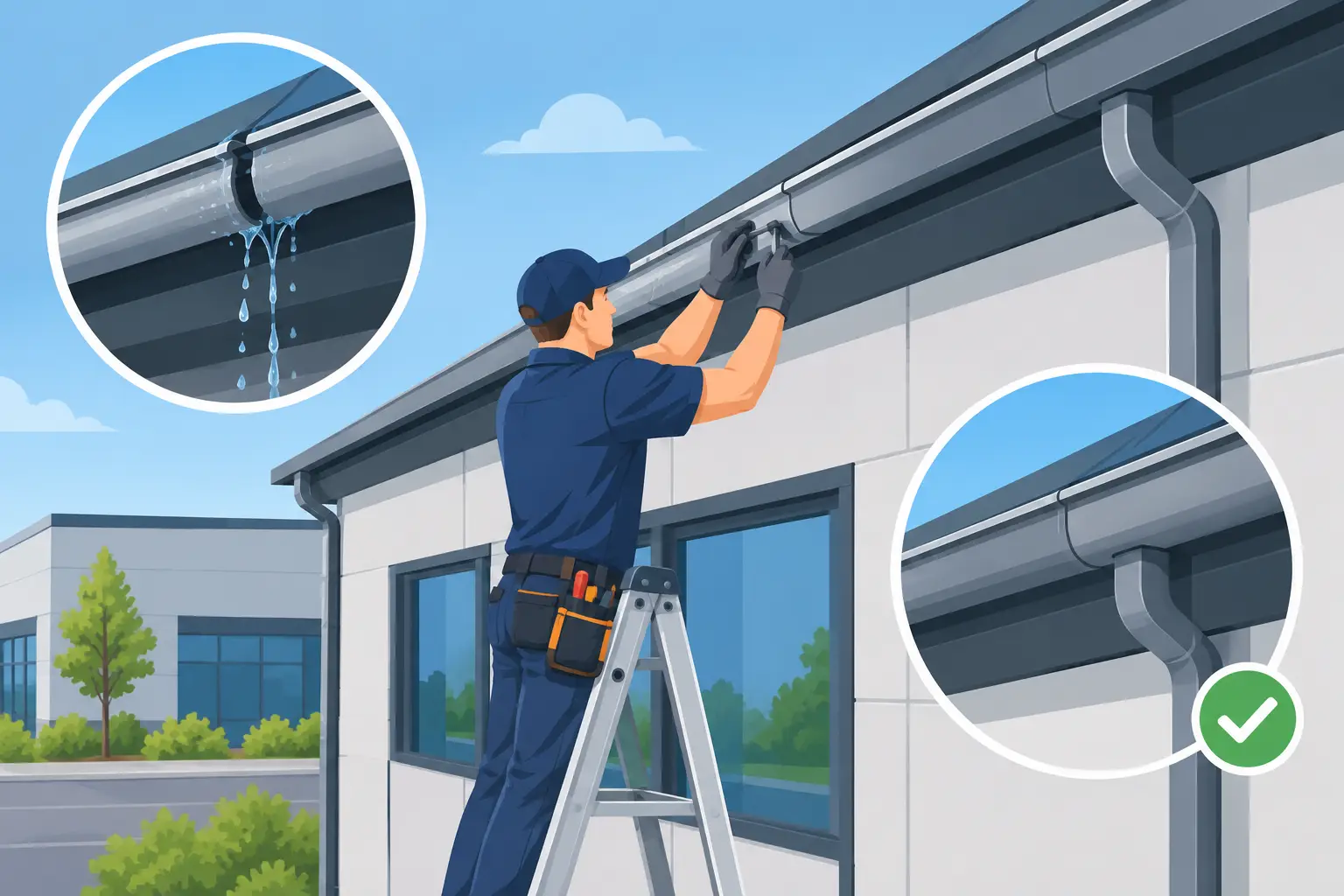
However, clearing the blockage alone would not have provided a lasting fix. One union joint had deteriorated and was leaking during heavier rainfall. Several brackets had also become loose, causing a shallow dip in the gutter. Instead of running consistently toward the outlet, water was pooling in that low section.
This is where commercial maintenance can go wrong when it is treated as a clean-only job. A vacuum can remove loose debris, but it cannot reseal a failed joint, reset gutter alignment, tighten brackets, or confirm that a downspout is draining freely. The work needs to match the condition of the system.
The Repair Work Carried Out
Once the faults were identified, the gutter and downspout were cleared fully. Debris was removed by hand where necessary, with the outlet cleaned so water could enter the downspout without obstruction. The downspout was then cleared and checked to make sure water could pass through the full length rather than backing up at the lower bend.
The leaking joint was dismantled, cleaned, and fitted with an appropriate new seal before being reassembled securely. A good joint repair depends on clean connecting surfaces. Applying sealant over dirt, old residue, or a poorly seated fitting may slow a leak temporarily, but it is unlikely to hold up through repeated rain and temperature changes.
Next, the loose brackets were secured and the affected length of gutter was reset to restore the correct fall. Gutters should not be completely level. They need a gradual slope toward the outlet so rainwater travels away instead of sitting in the channel. Too much slope can look poor and affect capacity, while too little allows standing water, dirt buildup, and eventual overflow. The right adjustment depends on the length of the run, the gutter type, and the number and position of outlets.
The repair was followed by a water-flow check. This is a simple but essential part of the work. Water was run through the repaired section to confirm that it traveled to the outlet, entered the downspout, and discharged away from the doorway without leaking at the joint or spilling over the gutter edge.
The result was not just a cleaner gutter. The system was restored to do its job: collect roof water, direct it through the downspout, and keep it away from the building and walking areas.
Why the Overflow Was a Safety Issue
The wet patch beside the service entrance was more than an inconvenience. On commercial premises, standing water can increase slip risk for staff, visitors, contractors, and delivery drivers. If water regularly runs down brickwork or siding, it can also leave stains and encourage damp problems around openings and lower wall areas.
Where water reaches wood fascia, soffits, or roofline boards, ongoing overflow can lead to rot and peeling finishes. On buildings with metal cladding, repeated runoff may leave streaking and create unsightly marks. These issues are usually more expensive to address than a timely gutter repair.
The best solution depends on the building. A short retail frontage may only need a cleaned outlet and a new seal, while a larger industrial unit may have undersized drainage, damaged brackets across several elevations, or multiple downspouts that need clearing. A repair should be based on what the inspection finds, not a one-size-fits-all package.
When Repair Is Better Than Replacement
Replacement is not always necessary. If the main gutter lengths are sound and the problem is limited to debris, loose brackets, worn seals, or a damaged fitting, a targeted repair can offer good value. It deals with the immediate risk without replacing material that still has plenty of service life.
Replacement becomes the better option when there are widespread cracks, badly corroded sections, repeated joint failures, sagging across long runs, or gutters that are too small for the roof area. The same applies if old systems have been patched repeatedly and continue to leak. Spending money on another short-term repair is not good value if the system is failing throughout.
A straightforward inspection helps property managers make that decision with clear information. It should distinguish between work needed now, work worth planning for, and purely cosmetic concerns. That approach avoids both unnecessary replacement and the false economy of ignoring a developing problem.
What Property Managers Should Check After Heavy Rain
After rainfall, walk the outside of the building if it is safe to do so. Look for water spilling over gutter edges, drips from joints, wet marks below rooflines, overflowing downspouts, pooling near entrances, and water running toward the foundation. These signs help identify drainage faults before damage becomes more serious.
Do not attempt high-level repairs from ladders without the right access equipment, training, and insurance. Commercial sites often have uneven ground, busy access routes, fragile roof areas, or overhead hazards. A professional contractor can inspect the system safely and carry out cleaning, repair, and replacement work where required.
At Steve’s Gutters, the focus is on addressing the full cause of a gutter issue, including the gutter run, joints, outlets, downspouts, and roofline condition. That matters because water does not care which part of the system has been overlooked.
A commercial gutter repair is most cost-effective when it is arranged at the first signs of overflow, rather than after water has caused damage at an entrance or along an exterior wall. If rainwater is going anywhere other than the downspout, it is time to have the system checked properly.
Recommended Posts
Seamless Versus Sectional Gutters: Which Is Best?
October 16, 2026

Can Dirty Gutters Attract Pests? Yes, Here’s Why
October 14, 2026
A Guide to Replacing Fascias on Your Home
October 12, 2026