

Hand Cleared Gutters vs Vacuum: Which Is Better?

by
A gutter can look clear from the ground and still hold compacted moss, standing water, or a blocked downpipe. That is why the choice between hand cleared gutters vs vacuum is about more than the cleaning method. It is about whether the whole gutter system is checked, cleared, and left working properly.
Gutter vacuums have a useful place in routine maintenance, especially where access is limited. Hand clearing gives a technician closer inspection and the ability to deal with faults as they are found. For many homes, the best service uses the method that suits the property, rather than treating vacuum cleaning as the answer to every job.
What hand-cleared gutter cleaning involves
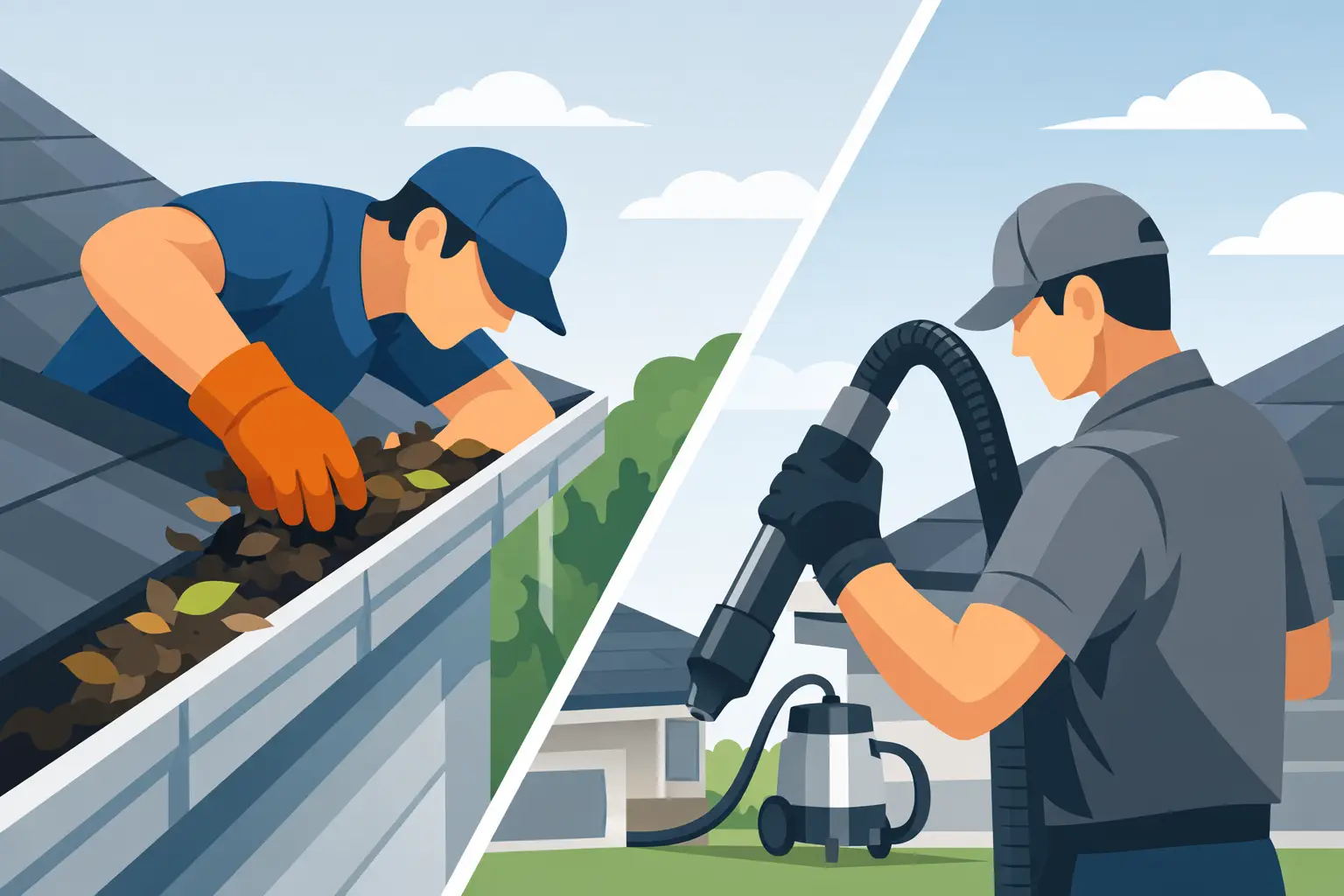
Hand clearing means a trained operative accesses the gutter safely, removes debris by hand, and checks the condition of the channel, joints, brackets, outlets, and nearby roofline. Leaves, moss, silt, nesting material, and compacted debris can be removed directly rather than pulled through a vacuum hose.
This approach is particularly useful when gutters have been neglected for several years or are visibly overflowing. Heavy moss often forms a dense mat around outlets and cannot always be lifted cleanly from ground level. A hands-on clean allows the operative to clear the outlet properly and confirm that water can reach the downpipe.
It also provides a better opportunity to spot issues that cleaning alone will not fix. A loose union, cracked section, sagging run, damaged bracket, or failed downpipe connection can all cause leaks. If nobody gets close enough to inspect them, the customer may pay for a clean and still have water running down the wall during the next heavy rainfall.
Hand clearing does not mean taking unnecessary risks. Proper access equipment, trained staff, and a site-specific safety assessment matter. Some properties are not suitable for ladder access, while others need a combination of safe access and ground-based equipment.
How gutter vacuum cleaning works
A gutter vacuum uses a powerful machine and long carbon-fiber poles to remove loose debris from the ground. The operative positions the pole over the gutter and draws material into the collection unit. Camera systems can also be used to view the gutter line before and after cleaning.
The main advantage is reduced work at height. On straightforward homes with dry leaves, loose moss, and accessible gutter runs, a vacuum can be quick, tidy, and effective. It can also be useful around conservatories, lower roofs, extensions, and areas where ladder positioning would be difficult.
Vacuum cleaning is not automatically a lesser service. A capable operator can remove a significant amount of debris and verify results with a camera. For routine annual maintenance, particularly on a property with no known defects, it may be the sensible option.
The limitation is that a vacuum cannot repair a failing joint, reseat a downpipe, replace a broken bracket, or always release debris that has been packed hard around an outlet. It may remove what it can reach while leaving a blockage further down the system. That is why the quality of the inspection matters as much as the machine being used.
Hand cleared gutters vs vacuum: the practical differences
The right method depends on the condition of the gutters, access around the building, and whether there is an active drainage problem. A vacuum service is usually strongest when the goal is maintenance. Hand clearing is often stronger when there are signs of failure or when a full condition check is needed.
Inspection and repairs
A vacuum can show whether debris remains in a gutter channel, but it cannot physically test every joint or bracket. Hand clearing allows a closer look at the gutter’s condition and makes it easier to identify the cause of staining, dripping, or overflow.
This matters when rainwater is escaping at a particular point. The problem may be a blockage, but it could also be incorrect gutter fall, a separated joint, a cracked outlet, or a downpipe that has come loose. A proper service should identify the issue rather than assume every leak is caused by leaves.
For property managers, this can save repeat callouts. A clean-only visit may be cheaper at first, but it offers less value if a small repair is missed and leads to water damage around fascias, brickwork, windows, or foundations.
Stubborn blockages and downpipes
Loose debris is ideal for vacuum removal. Wet silt, compacted moss, and old leaf mulch are a different matter. When debris has settled for a long time, it can block outlets like a plug and may need to be broken up and removed by hand.
Downpipes deserve special attention. A gutter can be spotless but still overflow if the downpipe is blocked below the outlet. A reliable gutter service checks that water has a clear route away from the roofline. Where there is a blockage, it should be cleared or clearly reported, not ignored because the gutter itself looks better on camera.
Access and safety
Vacuum cleaning has a genuine safety advantage on properties where working at height would be impractical or unsuitable. It reduces the need for ladders and can reach many upper-level gutters from the ground.
That said, ground-based cleaning is not a substitute for safe professional judgment. A property with fragile roof sections, awkward access, overhead cables, uneven ground, or severe gutter damage may need a different plan. The safest method is the one chosen for the building, not the one advertised as fastest.
Price and value
Vacuum cleaning may be quicker on an uncomplicated property, which can make it cost-effective for regular maintenance. Hand clearing can take longer because it includes closer inspection and direct removal of difficult debris.
The cheapest quote is not always the best value. Ask what is included: Are downpipes checked? Is before-and-after evidence provided? Will obvious gutter defects be reported? Can the company carry out repairs if they are needed? A service that only removes debris may be enough for some homes, but it is not the same as a full gutter health check.
When vacuum cleaning is the right choice
Vacuum cleaning is a good fit for gutters that are maintained regularly, have loose and dry debris, and show no obvious signs of leaks or damage. It can be especially practical for taller gutter lines and extensions where access is restricted.
It is also useful as part of a planned maintenance schedule. Homes beneath light tree cover may benefit from cleaning once or twice a year, depending on the number of trees, nearby moss growth, and local weather. Keeping debris from building up in the first place makes any cleaning method more effective.
A camera check should be part of the conversation. It gives the homeowner or manager a clearer view of the work completed and can highlight areas that need further attention.
When hand clearing is worth it
Choose hand clearing when gutters are overflowing, debris is heavily compacted, outlets are visibly blocked, or there is evidence of leaking at joints and downpipes. It is also the better option when you want a closer inspection before buying repairs or replacement work.
Older properties often benefit from this approach. Cast iron systems, aging brackets, and older rooflines can have hidden weaknesses that deserve careful attention. The same applies to gutters above conservatories, where poor drainage can lead to dirty glazing, damp edges, and unnecessary strain on the structure below.
A hands-on visit can also be worthwhile after major storms, roof moss removal, or building work. These situations often send extra debris into the gutter system and can expose faults that were not apparent before.
A good gutter service is not defined by the equipment
The best question is not, “Do you use a vacuum?” It is, “Will you make sure the gutters and downpipes are actually working?” A professional should be able to explain the cleaning method, show what was found, and advise honestly when a repair is needed.
At Steve’s Gutters, the focus is on solving the full problem, whether that means clearing debris, checking drainage, repairing a leaking section, or recommending replacement where the system has reached the end of its life. That practical approach matters more than a one-size-fits-all method.
If your gutters are due for cleaning, look for a service that matches the method to the condition of the property. A clear gutter is useful. A clear gutter that drains properly, stays securely fixed, and protects the roofline is the result worth paying for.
Recommended Posts

Seamless Versus Sectional Gutters: Which Is Best?
October 16, 2026

Can Dirty Gutters Attract Pests? Yes, Here’s Why
October 14, 2026
A Guide to Replacing Fascias on Your Home
October 12, 2026