

Repairing Storm Damaged Guttering Right

by
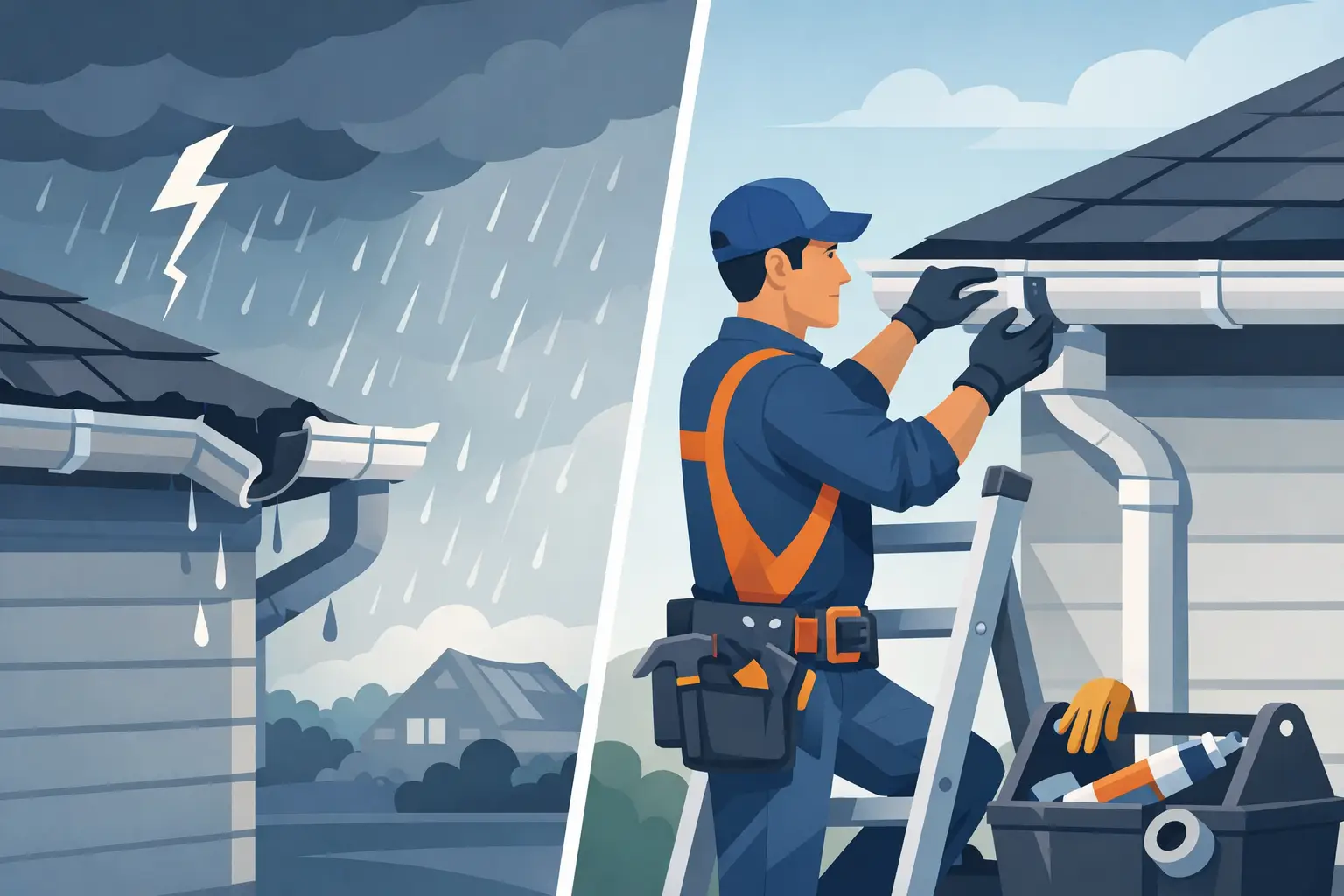
A heavy storm does not need long to expose weak guttering. One loose bracket, one joint that was already tired, or one downspout packed with debris can turn a normal rainfall into overflowing water running down walls and pooling around the base of a property. That is why repairing storm damaged guttering should be handled quickly and properly, not patched over and forgotten.
When gutters fail after high winds or driving rain, the damage is rarely limited to the gutter itself. Water can get behind fascia boards, stain siding, soak masonry, and create damp problems that cost far more than the original repair. For homeowners and property managers, the real question is not just what broke. It is whether the whole system is still doing its job.
What storm damage usually looks like
Storm damage is not always dramatic. Sometimes a section of gutter is hanging loose or a downspout has pulled away from the wall. Other times the signs are less obvious – water marks on brick, drips from joints, overflowing corners, or gutter runs that now slope the wrong way.
High winds often loosen brackets and spikes, especially on older systems. Heavy rain exposes blockages that were already forming in valleys, outlets, and downspouts. Falling branches can dent aluminum, crack plastic sections, or knock cast iron joints out of line. In freezing conditions, trapped water can expand and split connections that looked fine from ground level the week before.
This is where experience matters. A quick glance from below might suggest a small repair, but the real issue could be failed support spacing, rotten fascia behind the gutter, or multiple sections pulling apart under strain.
Repairing storm damaged guttering starts with the full system
A proper repair begins with an inspection of the full run, not just the visible break. If one section has failed, there is a fair chance nearby joints, brackets, or outlets are under the same stress.
That inspection should check the pitch of the gutter, the condition of the fascia it is fixed to, the strength and spacing of the brackets, and whether the downspouts are clear and secure. It should also look at roof edges, valleys, and any areas where debris may have washed into the system during the storm.
This is one reason many homeowners get frustrated with surface-level services. Clearing debris is useful, but cleaning alone does not solve damaged joints, warped runs, or failing fixings. A gutter system has to collect water, hold it, and move it away safely. If any part of that chain is failing, the repair needs to address it.
What can usually be repaired
A lot of storm damage can be repaired without replacing the full system. Loose brackets can often be refixed or replaced. Minor joint leaks may be resolved by resealing or renewing the connector. A detached downspout can usually be secured again if the pipe itself is still sound.
Small sections of cracked or dented gutter can often be cut out and replaced, provided the surrounding runs are in good shape. Misaligned lengths can be reset to restore the correct fall. In some cases, a blockage caused the overflow and the gutter itself is fine once cleaned and tested.
The material matters here. Aluminum systems can often be repaired neatly if the damage is local. UPVC is common and cost-effective, but once it becomes brittle with age, repairs can be short-lived if the plastic is already weakened. Cast iron is durable and worth preserving on the right property, but repairs need to be carried out with care because poor patching can look rough and fail early.
When repair is the wrong call
Not every storm-damaged gutter should be repaired. Sometimes replacement is the better value, especially when the damage has simply exposed a system that was already at the end of its life.
If multiple joints are leaking, several brackets have failed, and the gutter line is sagging in more than one area, patching one section after another can become false economy. The same applies if the fascia behind the gutter is rotten, because fresh fixings will not hold properly for long. Older systems with repeated repairs can keep costing money while still leaving the property at risk.
For commercial properties and larger homes, there is also the issue of reliability. If a building depends on long gutter runs and heavy water flow, one weak point can affect a large area quickly. In that case, replacing damaged sections or upgrading the whole run may be the safer and more sensible route.
The hidden damage storms can cause
One of the biggest mistakes after bad weather is assuming the problem ended when the rain stopped. Water from failed guttering can take time to show itself.
You may notice paint peeling near rooflines, green staining on exterior walls, damp smells near upper rooms, or puddling around entrances and patios. Over time, repeated overflow can stain brickwork, encourage mold growth, soften timber, and wash away ground around the foundation. None of that is good news, and all of it starts with water not being controlled properly.
That is why repairing storm damaged guttering is not only about tidying up visible damage. It is about protecting the rest of the property from the effects of uncontrolled runoff.
Why safety should not be an afterthought
Storm damage often leaves gutters unstable. Sections may be hanging on by one fixing, downspouts may be twisted, and nearby roof edges can be slippery with debris. That makes post-storm gutter work more dangerous than routine maintenance.
For single-story areas, some homeowners are comfortable carrying out a visual check from a stable ladder. Even then, it makes sense to keep it to observation rather than repair. Leaning into damaged guttering, trying to reseal wet joints, or forcing a blocked downspout clear without the right access and equipment can make the damage worse.
For two-story properties, extensions, conservatories, and commercial units, safe access is a serious part of the job. A proper repair should be done by a fully insured specialist who can inspect, clean, repair, and test the system without guessing.
What a good repair service should include
A proper storm-damage callout should not end with a bit of sealant and a quick invoice. At minimum, the work should include a full check of the affected gutter run, the outlets, and the downspouts, along with a clear explanation of what failed and why.
The repair itself should use matching materials where possible, secure brackets correctly, restore the right fall, and test water flow before the job is signed off. If fascia, soffit, or roofline issues are contributing to the problem, that should be pointed out plainly. Honest advice matters more than a cheap temporary fix.
That is the difference between a proper gutter specialist and a provider offering a basic clean-only service. Real value comes from solving the cause of the overflow, not just removing the evidence of it.
Preventing the next storm from causing the same problem
No gutter system is storm-proof forever, but regular maintenance makes a major difference. Most storm failures happen where gutters were already under strain from debris, age, weak fixings, or poor alignment.
Routine inspections help spot loose brackets, minor leaks, and early sagging before bad weather turns them into urgent problems. Cleaning out gutters and downspouts before the wet season helps maintain flow and reduces the weight that builds up during heavy rain. Trees close to the roofline also need watching, because falling twigs and leaves are often the start of bigger blockages.
For older properties, it is worth checking whether the guttering still suits the roof area and water load. Extensions, conservatories, and altered rooflines can change how rainwater moves. A system that was once adequate may now be undersized or poorly arranged.
Choosing the right fix for your property
The right answer depends on the age of the guttering, the type of material, the extent of the storm damage, and the condition of the roofline behind it. A small local repair may be entirely sensible for a modern system in otherwise good order. A tired, leaking run with repeated failures may need more than patchwork.
What most property owners want is simple – a repair that holds, a fair price, and the confidence that the issue has been dealt with properly. That means getting clear advice from someone who understands not only gutters, but how the whole exterior drainage setup works.
At Steve’s Gutters, that practical approach matters because storm damage is rarely just one broken clip or one overflowing joint. It is usually a warning sign that the system needs a proper look.
If your guttering has taken a hit after bad weather, do not wait for the next storm to tell you how serious it is. A timely repair is always cheaper than water damage that has had weeks to spread.
Recommended Posts
Seamless Versus Sectional Gutters: Which Is Best?
October 16, 2026
Can Dirty Gutters Attract Pests? Yes, Here’s Why
October 14, 2026
A Guide to Replacing Fascias on Your Home
October 12, 2026