

Blocked Gutter Water Damage Example at Home


by
You usually do not notice a gutter problem when the sun is out. You notice it during a hard rain, when water starts spilling over the edge, running down brickwork, and pooling where it should never be. A blocked gutter water damage example is often less dramatic than a roof collapse, but more expensive than most homeowners expect because the damage spreads slowly through several parts of the property at once.
The common mistake is assuming the gutter is just full of leaves and needs a quick clean. Sometimes that is true. Just as often, the blockage has already pushed water behind the gutter, loosened joints, soaked fascia boards, and overloaded a downspout. By the time staining appears indoors or the patio starts holding water against the wall, the problem has moved beyond a simple overflow.
A real-world blocked gutter water damage example
Picture a two-story home with a rear extension and a conservatory below the roofline. The gutter along the back of the house has collected moss from the roof, leaves from a nearby tree, and silt that has built up over a few seasons. The downspout is partially blocked as well, so rainwater cannot drain at the speed it should.
At first, the signs are easy to miss. During light rain, the system copes. During heavy rain, water pours over one section near a joint and runs straight onto the fascia and soffit. Some of it lands on the conservatory roof. Some of it tracks down the wall. Because the gutter is holding standing water, the added weight begins to pull the bracket line out of level.
A few months later, the homeowner notices peeling paint near an upstairs window, black staining on the siding, and damp patches where the extension wall meets the ceiling. Outside, the patio by the back door stays wet long after the rain has stopped. In colder weather, that repeated saturation and drying cycle starts affecting the masonry joints.
This is how gutter neglect turns into property damage. It is rarely one single failure. It is a chain of smaller ones.
Where blocked gutters cause damage first
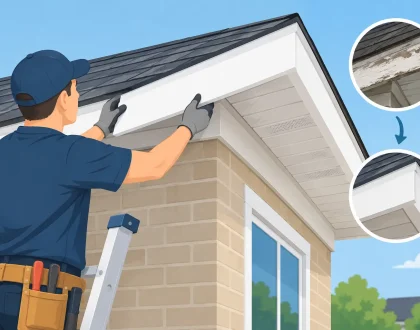
The first area at risk is usually the roofline. When water cannot move freely to the downspout, it backs up and spills in the wrong places. Timber fascia boards can begin to rot. Even with UPVC rooflines, trapped water can still reach fixings, joints, and the edges of the roof structure. If the gutter has started to sag, water may run toward the house instead of away from it.
Walls come next. Overflowing water repeatedly soaking brick, render, or siding leads to staining, algae growth, and moisture penetration. Some wall finishes tolerate occasional wetting better than others. Rendered surfaces and older masonry often show the effects sooner, especially on exposed elevations.
Foundations are the part many people overlook. Gutters are there to move roof water away from the base of the building. When they fail, that water ends up saturating the soil around the property. On some homes, especially where drainage is poor or patios slope back toward the wall, this can contribute to settlement issues, internal damp, or water entering basements and lower-level rooms. It depends on the site, but it is never a risk worth ignoring.
Why one blockage often means more than one problem
A blocked gutter is not always just a blocked gutter. Debris may be the starting point, but once water has been overflowing for a while, you often find secondary issues. Joints can leak, brackets can pull loose, downspouts can pack solid, and seals can fail under constant pressure.
That is one reason cheap, clean-only services can fall short. Removing visible debris helps, but it does not tell you whether the gutter is still properly aligned, whether outlets are running clear, or whether the overflow has already damaged parts of the system. A proper service looks at the whole run, not just the muck inside it.
For homeowners and property managers, that matters because surface symptoms can be misleading. The wet patch on the wall may make you think you need decorating work first. In reality, the source could still be active above your head every time it rains.
Signs your property may already fit this blocked gutter water damage example
You do not always need a ladder to spot trouble. If you see water cascading over the gutter edge in rain, that is the obvious one. Less obvious signs include dark streaks on exterior walls, green growth near gutter lines, peeling paint around roof edges, or persistent damp smells near upper rooms and extensions.
Watch the ground too. If one area by the wall stays soggy, if puddles form below a downspout, or if gravel channels are washing out, water is not being controlled properly. Conservatories and flat-roof extensions are especially vulnerable because overflow from the main house can dump a large volume of water onto a smaller structure below.
Inside the building, the warning signs may show up as bubbling paint, ceiling stains, or cold damp corners. That does not always mean the gutter is the only cause, but it is one of the first things worth checking because it is so often involved.
Why timing makes a big difference
Gutter problems are cheapest when caught early. If debris is cleared before water starts backing up, the fix may be straightforward. Once timber rot, internal damp, or masonry deterioration begins, costs rise quickly because you are no longer dealing with maintenance alone. You are paying for repairs to the building fabric as well.
Season matters too. Fall and winter usually expose hidden issues because gutters fill faster and heavy rain tests weak points. Freezing conditions can make things worse. Water trapped in blocked sections expands when it freezes, putting extra stress on joints and brackets. A gutter that copes badly in November may fail completely by January.
For commercial sites and managed properties, the risk is not just repair cost. It is disruption, safety concerns, and the knock-on effect of water reaching entrances, walkways, or occupied spaces.
What proper gutter servicing should include
A worthwhile gutter service goes beyond scooping out leaves. The system should be checked for flow, alignment, and sound fixings. Downspouts should be tested or cleared, not just glanced at from ground level. Leaks at joints and corners should be identified. If the roof is shedding heavy moss, that should be part of the conversation too, because the gutter will simply block again if the source is left untouched.
This is where experience counts. A contractor who handles cleaning, repairs, and replacement can tell the difference between a gutter that needs maintenance and one that has reached the point where patching it is false economy. That saves homeowners from paying twice.
At Steve’s Gutters, that practical approach is the whole point. If a blocked run has also caused a leaking joint, a failed bracket, or a damaged section of fascia, the aim is to deal with the actual issue rather than stop at a basic clean and leave the rest for later.
Prevention is cheaper than repair, but only if it is done properly
Not every property needs the same cleaning schedule. A house under mature trees may need attention far more often than a newer home in an open setting. A building with multiple roof valleys, extensions, or conservatories will usually have more places for debris to collect and overflow to cause damage.
The right schedule depends on the property, the surrounding environment, and the condition of the current guttering. Annual cleaning may be enough for some homes. Others need more frequent checks, especially after storms or heavy leaf fall. What matters is consistency. Waiting until water is pouring over the side usually means the damage has already started.
If you take anything from this blocked gutter water damage example, let it be this: gutters are not just there to look tidy along the roofline. They protect walls, windows, roof edges, patios, and foundations every time it rains. Keeping them clear and properly repaired is one of the simplest ways to avoid a much bigger bill later.
Recommended Posts

Seamless Versus Sectional Gutters: Which Is Best?
October 16, 2026

Can Dirty Gutters Attract Pests? Yes, Here’s Why
October 14, 2026
A Guide to Replacing Fascias on Your Home
October 12, 2026