

What Causes Overflowing Gutters?

by
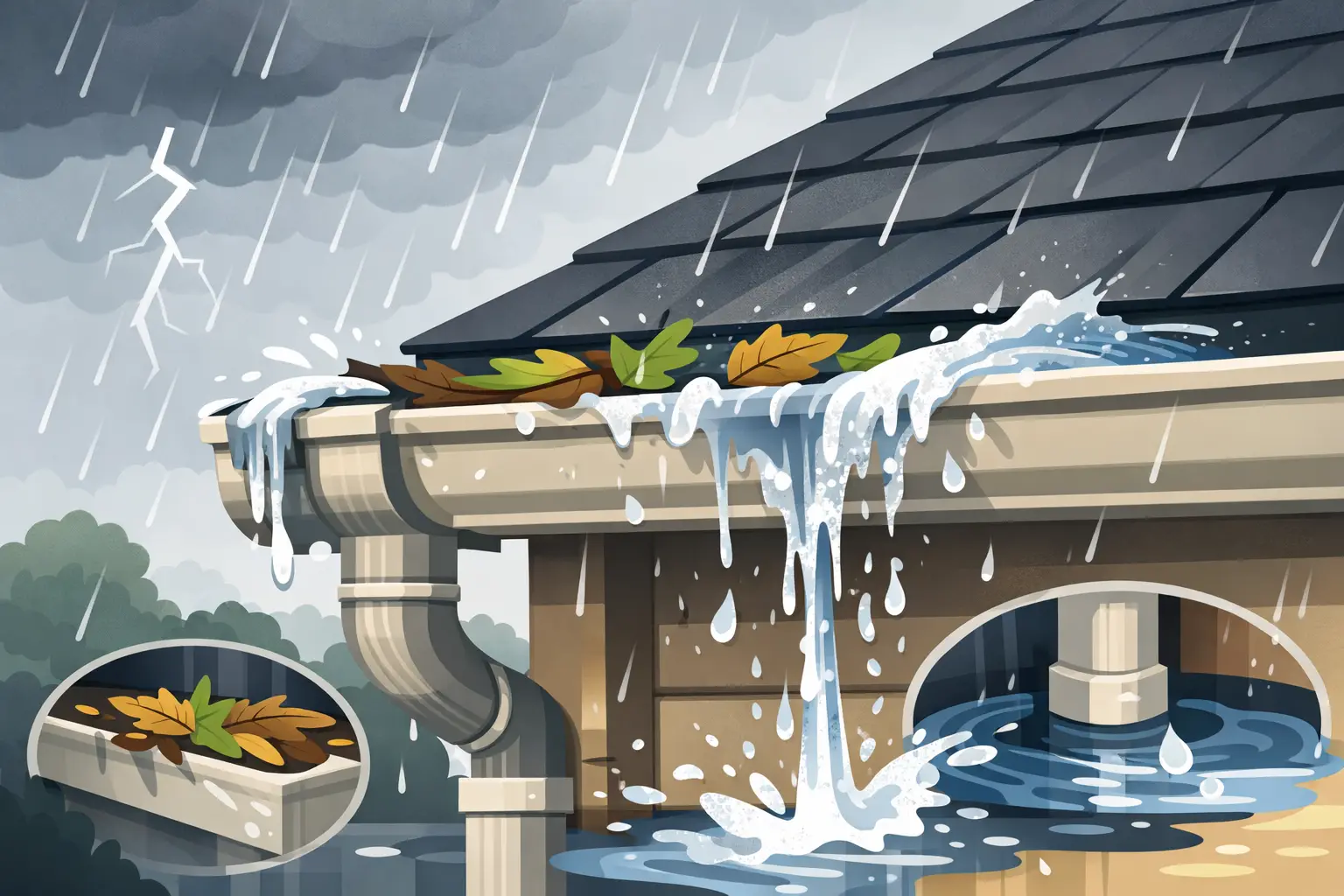
You usually notice it during a hard rain. Water should be moving neatly through the gutter and down the downspout, but instead it spills over the front edge, runs down the wall, and starts soaking the ground below. If you are wondering what causes overflowing gutters, the short answer is that water is being stopped, slowed, or pushed out of the system somewhere. The real issue is finding out why.
An overflowing gutter is not always just a cleaning problem. Sometimes the trough is packed with leaves and moss. Sometimes the downspout is blocked. Sometimes the gutter itself is loose, pitched the wrong way, or simply too worn out to do its job properly. That is why a proper inspection matters. A quick clean without checking the rest of the system can leave the actual fault untouched.
What causes overflowing gutters in the first place?
In most cases, overflowing starts when rainwater cannot move through the gutter channel fast enough. That can happen because debris is taking up space, because the outlet to the downspout is blocked, or because the gutter is not draining in the direction it was designed to. During heavy rainfall, even a partial restriction can be enough to send water over the side.
The most common cause is buildup. Leaves, twigs, roof moss, grit from shingles, and general dirt collect over time. On homes with nearby trees, that buildup can happen much faster than many owners expect. On commercial buildings, long gutter runs can hide a blockage until a storm exposes it.
There is also a difference between a gutter that overflows in one small area and one that overflows along a whole section. A local overflow often points to a blockage or a bad joint. Overflow across a long run often suggests poor pitch, undersized gutters, or a downspout issue affecting the entire line.
Blocked gutters are the obvious cause, but not the only one
A full gutter cannot carry water properly. Once debris starts trapping moisture, it becomes heavier and more compact. Wet leaves form a mat. Moss breaks down and turns sludgy. Small bits of dirt then settle into the bottom and reduce the channel even more.
This is why gutters can appear only partly dirty from the ground but still fail badly in rain. The top may not look packed solid, yet the flow path to the outlet can be narrowed enough to cause overflow. By the time water is pouring over the edge, the blockage has usually been building for quite a while.
The trouble is that people often stop at cleaning and assume the problem is solved. If brackets are loose, joints are leaking, or the fall is wrong, the gutter may still overflow after the debris is removed.
Downspouts often cause the real backup
A gutter can look fairly clear and still overflow because the downspout is blocked lower down. Water reaches the outlet, cannot escape properly, and backs up until it spills over. This is especially common where roof moss has washed into the system or where debris has collected at bends in the downspout.
You may notice one section filling up quickly while the rest seems normal. That usually points to poor drainage at the outlet rather than a full-length blockage. On taller buildings, this is harder to spot without proper access, which is why surface-level guessing rarely tells the whole story.
Poor pitch stops water from draining
Gutters are meant to have a slight fall toward the downspout. If that pitch is too flat, water sits in the channel instead of draining away. If it has dropped in the middle or been installed incorrectly, water can pool in the wrong place and overflow long before it reaches the outlet.
This often happens gradually. Brackets can loosen, fascia boards can weaken, and sections can start to sag under the weight of standing water and debris. A homeowner may think the gutter only needs cleaning, when in fact the alignment has shifted enough to affect performance.
Poor pitch also creates a cycle. Standing water encourages more debris to settle. More debris adds weight. More weight causes more sagging. Left alone, a small drainage issue can become a repair or replacement job.
Leaking joints and damaged sections can push water out
Not every overflow is a top-edge overflow. Sometimes water escapes through failed joints, cracks, holes, or separated sections and gives the impression that the gutter cannot cope with rainfall. In reality, the water is leaving through the weakest point before it ever reaches the downspout.
Older plastic systems can become brittle. Metal gutters can corrode. Seals can perish. Fixings can pull away from the fascia. Once that happens, even normal rain can produce visible runoff down walls and around windows.
This is one reason a proper gutter service should include repair capability, not just debris removal. If the system is damaged, a clean channel alone will not stop the leaking.
Roof runoff can overwhelm the gutter system
Sometimes the gutter is clean and intact, but the volume of water coming off the roof is simply too much for that section to manage efficiently. This can happen on steep roofs, large roof areas, extensions with awkward joins, conservatories, or areas where several roof slopes discharge into one run.
Heavy rain makes these design weaknesses more obvious. Water can shoot past the gutter edge if tiles project too far or if the flow comes off the roof too fast for the profile below to catch it. On some properties, splashover is made worse by poor previous installation rather than by a maintenance issue.
This is where experience matters. The right fix may be a larger gutter profile, an extra downspout, an adjustment to the alignment, or a roofline alteration. It depends on how the building sheds water.
What causes overflowing gutters even after cleaning?
If someone has already cleaned the gutters and the problem remains, it usually points to one of three things: a blocked downspout, poor gutter pitch, or damage to the system. It can also mean the cleaning was only partial and did not include checking outlets and downspouts properly.
This is a common frustration for homeowners. They pay for a quick service, the gutters look cleaner, but the next storm shows the same overflow. That does not mean gutter cleaning is pointless. It means the inspection was not thorough enough.
A proper job should look at flow, fixings, joints, outlets, and the condition of the guttering as a whole. If there is a problem with the fascia, soffits, or roof edge, that should be spotted too. Water rarely stays neatly in one problem area for long.
Signs the issue is getting serious
Some overflow problems are annoying but manageable for a short time. Others can start causing damage quickly. If water is repeatedly running down exterior walls, soaking brickwork, staining render, or collecting around the base of the building, the cost of delay climbs fast.
Watch for damp patches, peeling paint, green staining, eroded soil, or puddling near foundations. On homes with wood fascia or soffits, prolonged overflow can lead to rot. Around patios, driveways, and entrances, excess water can also create slippery surfaces and mess.
Inside the building, the signs may be less obvious at first. Moisture can track into roof edges, wall cavities, and around windows. By the time interior damp appears, the exterior problem has often been going on for longer than expected.
Cleaning, repair, or replacement?
That depends on the condition of the system. If the gutters are structurally sound and simply blocked with debris, cleaning and clearing the downspouts may be all that is needed. If joints are leaking or sections have shifted, a repair is usually the sensible next step.
If the guttering is old, sagging in several places, cracking, or undersized for the roof area, replacement may offer better value than repeated patchwork. That is especially true when related roofline components are also failing. There is little point repairing one weak section if the rest of the run is close behind it.
For homeowners and property managers, the practical question is not just what is cheapest today. It is what will stop the water problem properly. A low-cost clean-only visit can be false economy if the system really needs repair work.
Why proper maintenance matters
Overflowing gutters are rarely random. They are usually the result of gradual neglect, hidden damage, or an incomplete previous fix. The good news is that most problems can be dealt with before they turn into expensive water damage.
Routine inspection makes a real difference, especially after fall leaf drop, after storms, or when roof moss is visible. Properties with extensions, conservatories, or long rooflines often need more attention because they have more places where flow can go wrong.
A dependable contractor will not just remove the debris and leave. They will check whether the gutter is secure, whether water can drain freely, and whether the rest of the roofline is helping or hurting the system. That is the practical approach Steve’s Gutters is built around, and it is the reason many overflow issues are solved properly only after a full inspection.
If your gutters are overflowing, the most useful next step is not guessing from the ground. It is having the system checked by someone who can clean it, repair it, or replace it if needed, so the water goes where it should the next time it rains.
Recommended Posts
Seamless Versus Sectional Gutters: Which Is Best?
October 16, 2026

Can Dirty Gutters Attract Pests? Yes, Here’s Why
October 14, 2026
A Guide to Replacing Fascias on Your Home
October 12, 2026